Moonraker Atlas 10/11/12m Mini All Mode Radio review: a pocket-sized SSB rig with a smart noise reducer. Rough edges with room for improvement.
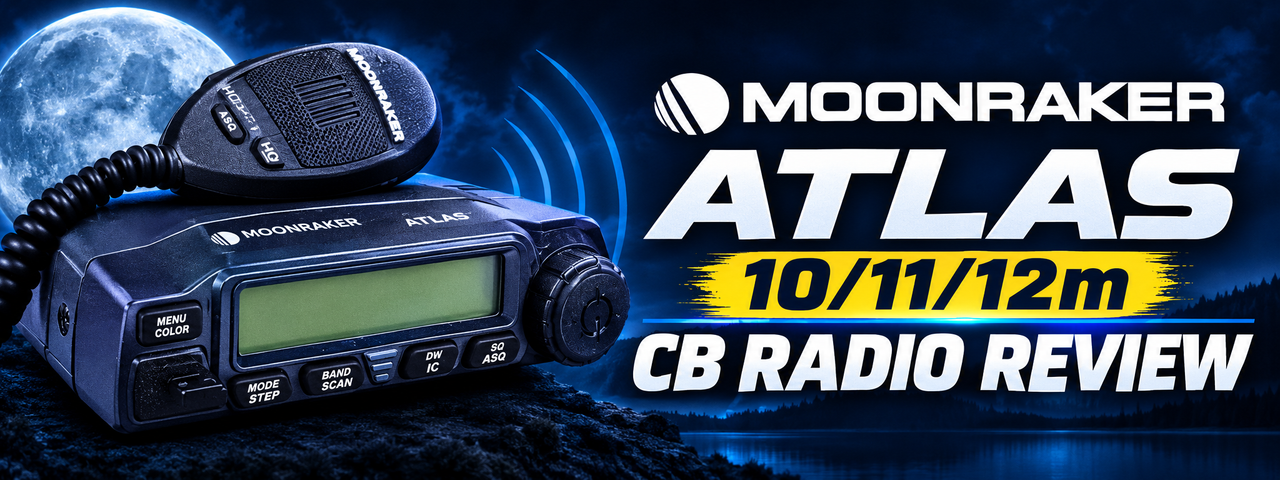
The Atlas (also known by other names) is an attempt to squeeze a full 10/11/12-metre multimode transceiver into something not much bigger than a cheese slice, for under £100. On paper it covers everything: AM, FM, USB and LSB, 15 W on SSB, dual watch, a clarifier and a 15-level DSP noise reducer. A power-on menu also switches it to 11 m, UK CB and other multi-norm channel plans. In practice, early owner reports describe a capable receiver and a strong SSB signal, wrapped around audio-path details that still feel unfinished.
25.615 – 30.105 MHz
AM · FM · USB · LSB · PA · 10 m, 12 m, 11 m CB and full HF coverage
- Output power
- SSB 15 W, FM 7 W, AM 7 W average, 16 W PEP
- Architecture
- PLL synthesiser, dual conversion (10.695 MHz / 455 kHz)
- SSB sensitivity
- 0.25 µV for 10 dB S+N/N
- SSB selectivity
- 2.6 kHz at -6 dB, 3.3 kHz at -60 dB (claimed)
- Supply
- 12–13.8 V DC, negative ground
- Size and weight
- 21 × 19 × 5 cm, 0.7 kg
- Antenna
- SO-239, 50 Ω
- Coverage settings
- 10 m 28.000–29.700 MHz (default), 12 m, 11 m CB with country codes (incl. UK 40), HF full coverage 25.615–30.105 MHz
- Launch price
- £99.95
Excellent value for compact mobile or portable SSB. Held back by quiet AM/FM transmit audio and a noise-reduction system that adds latency on transmit.
Receiver
The manual describes a conventional dual-conversion superhet: a 10.695 MHz first IF for SSB and a 455 kHz second IF. The quoted SSB sensitivity of 0.25 µV and FM sensitivity of 0.3 µV (12 dB SINAD) are respectable for the class.
The selectivity figures deserve some scepticism. A 2.6 kHz to 3.3 kHz span between the -6 dB and -60 dB points gives a shape factor of roughly 1.27, which is unusually tight at this price. Until someone puts it on a bench, treat it as an optimistic datasheet number. AM and FM are quoted at 6 kHz and 9 kHz, a shape factor of 1.5.
Frequency stability is specified at ±0.001%, which works out to about ±290 Hz at the top of the band. That is perfectly usable for SSB, and the one detailed hands-on report found the radio on frequency without needing the clarifier. The same reviewer called local reception clear, but poor band conditions meant no real DX testing, so long-haul weak-signal performance is still an open question.
Transmitter
Power is close to spec. That reviewer reported roughly 7–8 W on AM and FM and 16–18 W on SSB, which is about as much as anyone should expect from a radio this size. SSB transmit audio was described as strong, and each mode has its own mic gain setting. Output can be switched between high, mid and low.
AM and FM modulation is the weak spot. The same reviewer found FM clear but noticeably quieter than other radios, and a separate retail customer independently complained about low AM/FM transmit audio. Two reports from different people suggest this is not a one-off unit.
There is a partial fix. A hidden FM modulation menu, entered by holding BAND while powering on, offers three levels. The reviewer's estimate, made without test equipment, is about 1.5, 2.0 and 3.0 kHz of deviation. A figure near 3 kHz is a sensible target for 10 kHz-spaced 10m FM, but treat those numbers as unconfirmed. Hidden menus can change radio behaviour in ways you may not intend, so proceed at your own risk. Improving AM level reportedly requires a programming lead and software.
The microphone: a possible cause of the quiet audio
Charlie Tango Radio Hub argues the quiet, muffled transmit audio is not really just the radio's fault. Its claim is that the stock microphone is poorly designed, cheap and seems like an after-thought. The grille is mostly cosmetic: the holes in front of the actual microphone capsule are either tiny or blocked, and they sit well away from the actual capsule, so the capsule is starved of sound. Combined with FM deviation shipping at the minimum setting, that would explain why users report having to hold the mic very close to their mouth.
The fix it describes needs no software or soldering:
- Gently remove the front grille from the microphone.
- Drill a small hole in the top-right corner, where the housing has none, and check the tiny hole behind the grille is clear.
- Refit the grille.
- With the radio off, hold BAND while powering on, set the audio deviation to level 3, and press Power to confirm.
- Power the radio off and on again.
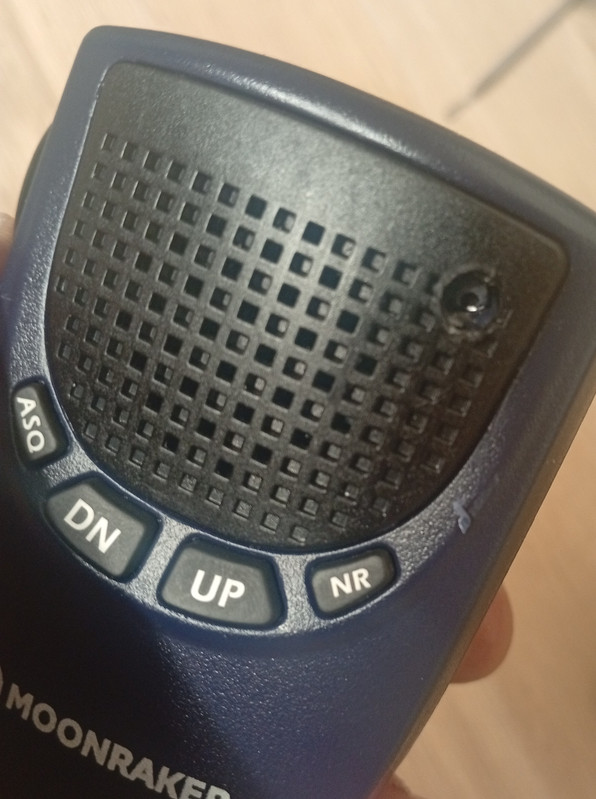
After the change, I found that you no longer need to hold the mic close to your mouth and the audio stops sounding muffled. This is my experience but I haven't seen it independently confirmed elsewhere. The mod also voids the microphone's warranty, bare this in mind before messing. The longer-term fix suggested is a better microphone, and an adapter exists for fitting a different one, though finding one in the UK is reportedly difficult.
AI noise reduction: the best feature and the biggest compromise
On receive, the 15-level noise reduction is the Atlas's party piece. Reports say it strips hiss and crackle effectively on every mode, with SSB benefiting most. Set at the right level, single-sideband stations can sound close to FM. The manual also lists a conventional noise blanker aimed at ignition and alternator noise, which is useful in a vehicle.
The catch is that the DSP also processes your transmit audio, and it cannot be limited to receive only. It reportedly takes around a quarter of a second to engage when you key up, then adds processing delay. Listeners hear an echo of your first word. Waiting half a second after pressing PTT works around it but is awkward. My suggestion is to compare lower NR levels on transmit, since a lighter setting may shorten the engagement delay.
Beyond 10m: 11m, UK CB and multi-norm operation
Out of the box the Atlas is a 28.000–29.700 MHz radio, but its firmware has an export mode that opens up much more. With the radio off, hold PTT while turning it on to choose the frequency coverage: 10 m, 12 m, CB or HF. The reviewer found switching between them took only a few presses.
- 11 m CB: select the CB setting, then choose a country code. Reported options include EU, I, PL, UK and US, among others, so one radio can follow several national channel plans. The UK setting covers the UK 40 channel plan.
- HF (full coverage): the widest setting, reported as 25.615–30.105 MHz, arranged in bands A to J. The Knights CB listing quotes the same expanded range.
- 12 m: available as its own setting.
One caveat on the numbers: the power, sensitivity and selectivity figures in the manual are quoted for the 10 m band. None of the sources I found give per-band measurements for CB or the wider HF range, but in my experience the Moonraker Atlas certainly does cover these bands with consistent power outputs which match the manufacturer claims.
Other things worth knowing
What works
- Compact build with positive-feeling buttons and a bright, legible display
- Seven backlight colours, with adjustable brightness
- Dual watch, clarifier, button lock, adjustable roger beep and echo
- Complete kit: microphone, mounting bracket and power lead
What doesn't
- Short hiss or crackle at key-up on at least one reviewed unit, noticed by other stations with squelch off
- Talkback feeds back even at its lowest setting
- Tinny internal speaker, so budget for an external one
- Stock microphone is criticised for muffled pickup and a so-so PTT feel
Price and what comes next
The Atlas launched at £99.95 and was reduced to £89.96 within weeks, then showed as out of stock. One retail commenter describes it as a clone from the same family as the Aquario, Luiton and Radtel mini radios, which suggests shared firmware lineage and possibly shared programming tools. The most detailed reviewer expects a Mark II, as happened with Moonraker's Titan. That is speculation, but it is a reasonable one.
Who should buy it
Buy it if you want a tiny, inexpensive SSB-capable 10 m rig for a vehicle or a portable station, and SSB is your main mode, especially if you also want one radio that can switch to 11 m CB and other multi-norm channel plans. The receive-side noise reduction and the output power are strong for the money.
Wait if you mainly use AM or FM, if you are sensitive to key-up artefacts, or if you can hold out for firmware updates, programming software or a revised version.
It's a lot of radio for the money and packaged in a small unit. As it stands in the current environment the price makes it an attractive radio to try. Honestly, there certainly is no other radio which comes close to the specification for less than £100. Most suppliers have sold out very fast but it's always worth checking Amazon.co.uk as they seem to be made available there first. However, the Amazon price is typically around £104 in the UK
How this review was put together
This review is compiled from the manufacturer's manual, retailer listings and published early-owner reports, plus my own analysis of the specifications. It is not based on bench measurements. Figures described as reported come from those owners and may vary between units.
- Charlie Tango Radio Hub: Atlas quiet audio fix and mic mod
- Moonraker Atlas instruction manual (Manuals+)
- Moonraker product page and customer comments
- Knights CB listing (dimensions, weight, expanded range)
- This page contains Amazon affiliate links and may earn this website a small commission from purchases made through those links.